
Table of Contents
The Ultimate Guide to PCB Assembly Cost: Breakdown, Drivers, and Expert Saving Tips
Estimating PCB assembly (PCBA) costs is a complex task, influenced by a wide range of factors—from material chemistry to labor rates and advanced testing techniques. For engineers and procurement managers in the US, Europe, and Australia, understanding these variables is the key to maintaining a project’s budget and timeline.
As a leading PCBA manufacturer based in Shenzhen, we bring years of hands-on experience to help you navigate the intricate cost structure of electronic manufacturing. In this guide, we break down the total cost of PCBA and provide expert strategies to optimize your investment.
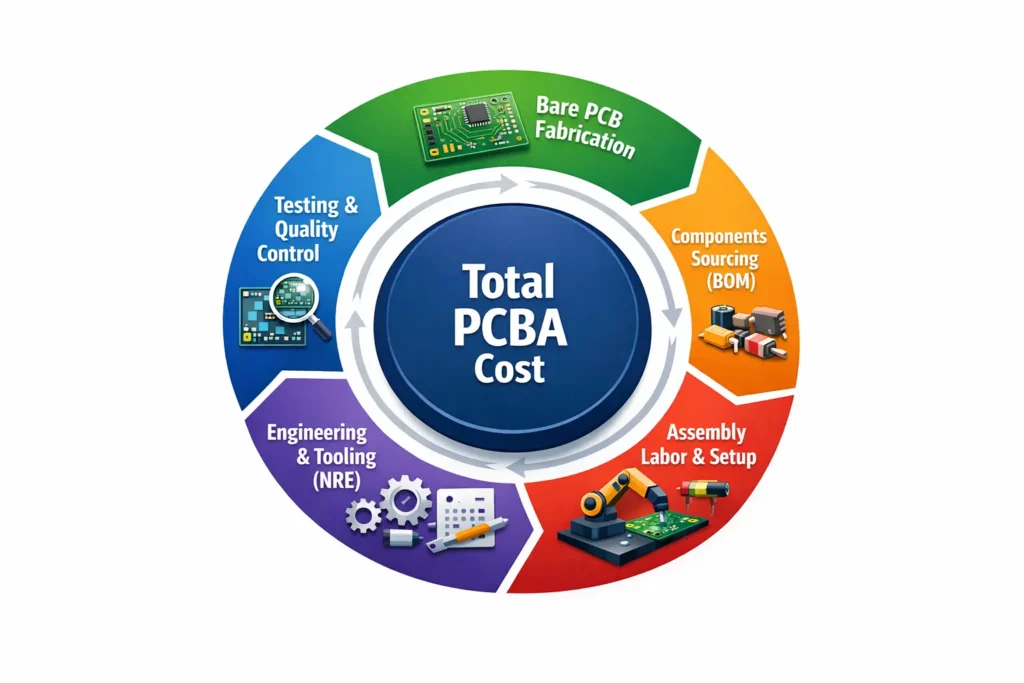
What Makes Up the Total PCB Assembly Cost?
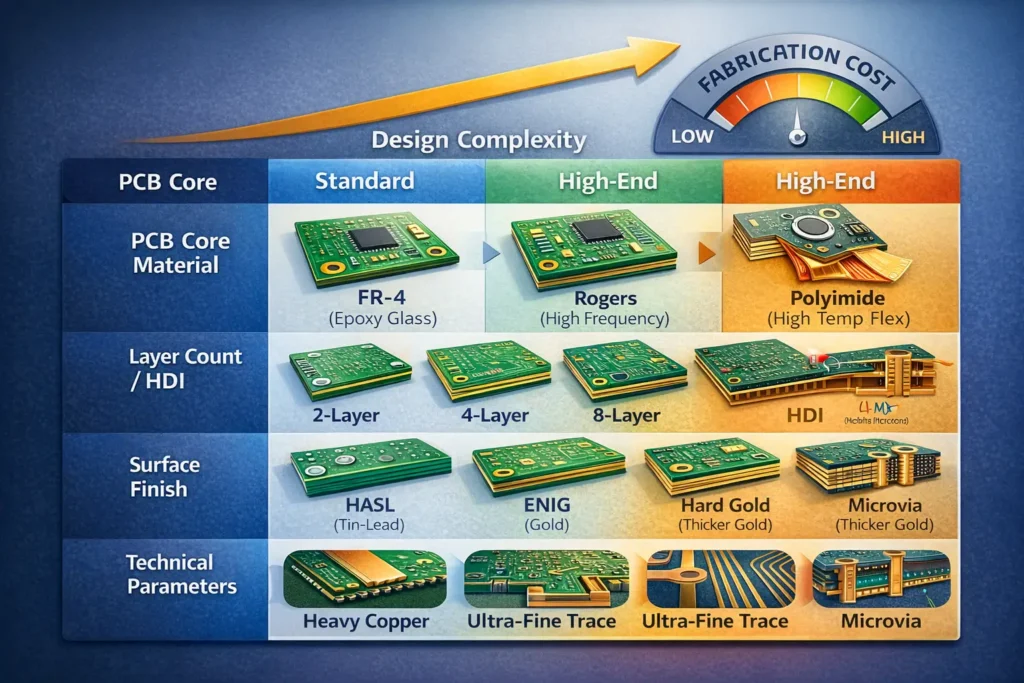
Bare PCB Fabrication Cost
- Material Selection: Standard FR-4 is cost-effective for most electronics. However, high-frequency, high-speed, or high-temperature applications require premium materials like Rogers or Polyimide (PI), which can cost several times more than FR-4.
- Layer Count & Complexity: Each additional layer increases the number of imaging, lamination, and drilling steps.
- Surface Finish: Options like ENIG (Gold) or Hard Gold offer better reliability and solderability but come at a higher price than HASL.
- Technical Parameters: Heavy copper thickness, ultra-fine trace width/spacing, and micro-via requirements (HDI) increase manufacturing difficulty and reduce yield, leading to higher costs.
Components Sourcing Cost (BOM)
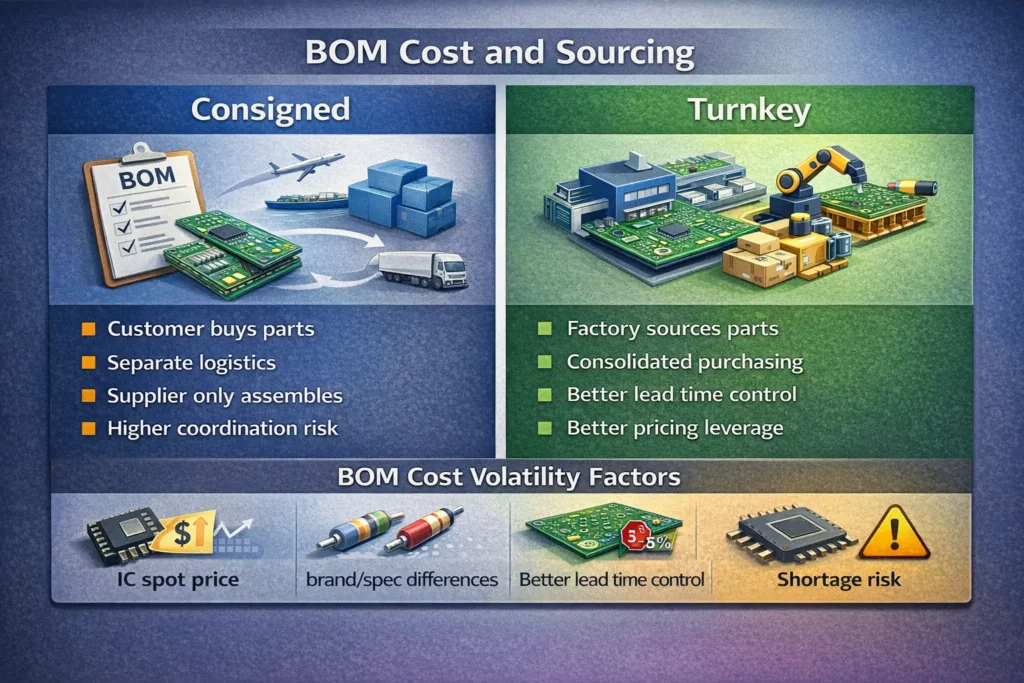
- BOM Total: The cost of all resistors, capacitors, ICs, and connectors. Prices vary wildly based on brand and specifications.
- Sourcing Strategy: You can choose Consigned (you provide the parts) or Full Turnkey (we source everything). Turnkey is often more cost-effective due to our bulk purchasing power.
- Market Volatility & Attrition: We factor in a small “scrap rate” (typically 3-5%) for SMT pick-and-place waste. Additionally, global supply chain fluctuations can impact the “Spot Price” of critical ICs.
Assembly Labor and Machine Setup
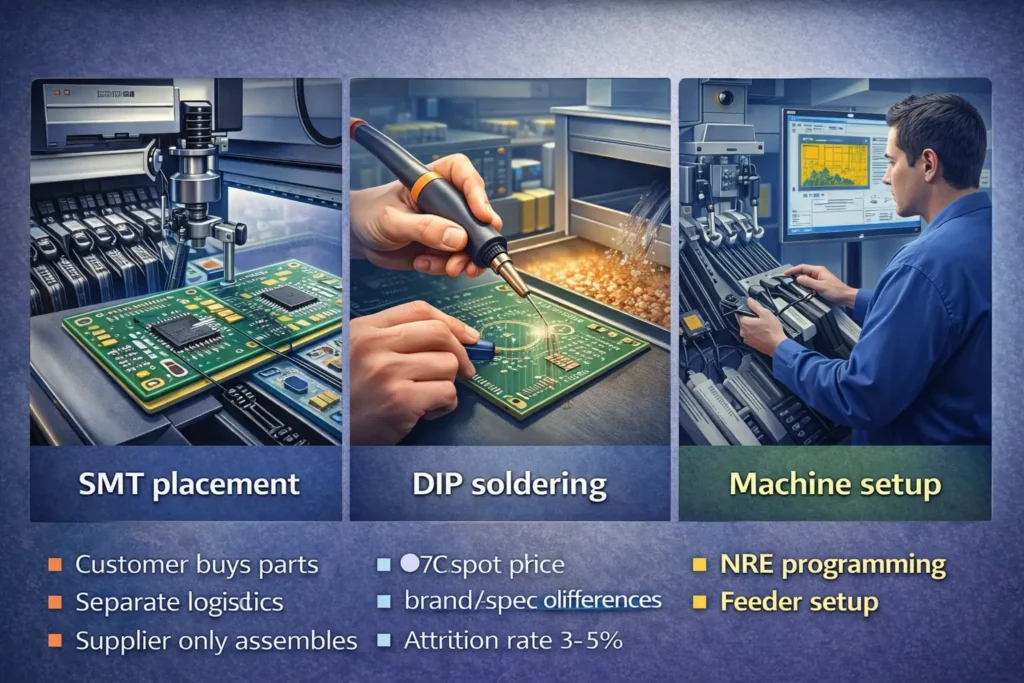
- SMT Processing: Fees are usually calculated by “Solder Points.” Costs depend on the speed/precision of the SMT lines and the complexity of the component packages.
- DIP (Through-Hole) Assembly: Manual soldering or wave soldering for components like large connectors. Because DIP is labor-intensive, it is often one of the hardest costs to compress.
- Engineering/Setup (NRE): For every new project, we must program machines and calibrate feeders. This Non-Recurring Engineering fee is usually charged separately for prototypes but amortized for mass production.
Testing and Quality Control
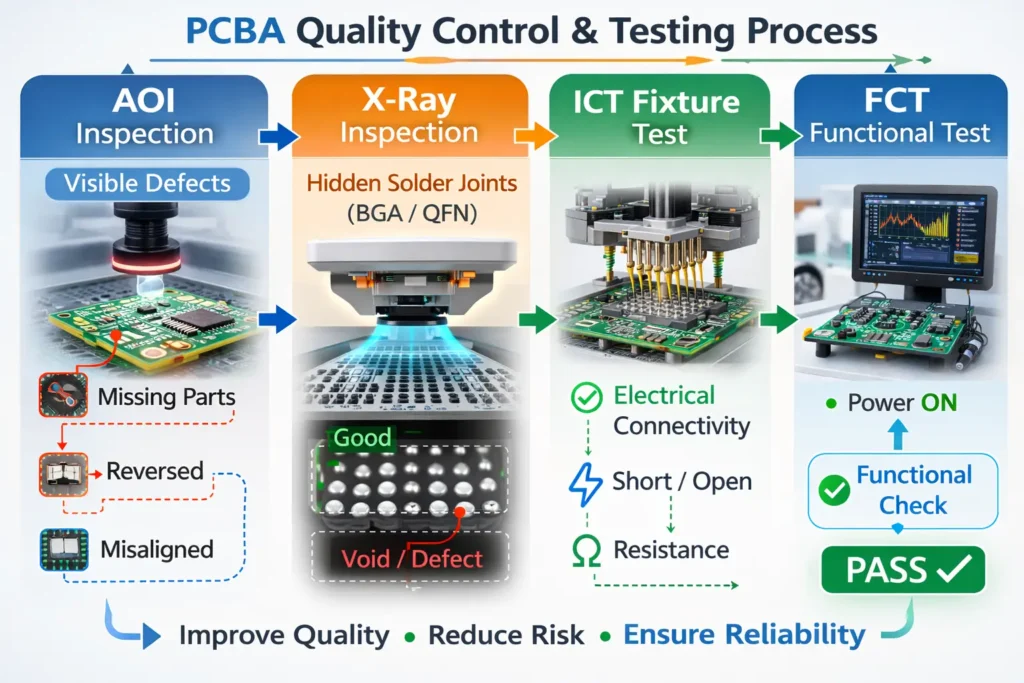
- AOI (Automated Optical Inspection): Standard for detecting placement defects like missing parts or polarity errors.
- X-Ray (AXI) Inspection: Essential for BGA, CSP, and QFN packages where solder joints are hidden. This requires expensive equipment and increases the unit cost.
- ICT & FCT: In-Circuit Testing (ICT) uses custom bed-of-nails fixtures to check electrical connectivity, while Functional Testing (FCT) simulates the product’s real environment. While fixtures require an upfront investment, they lower the unit cost for high-volume runs.
Engineering and Tooling Fees (NRE)
- Stencils: Laser-cut stainless steel stencils for solder paste application.
- Testing Jigs: Custom-built fixtures for FCT or ICT.
- DFM Review: Professional engineering feedback during the design phase to ensure high yield and lower long-term costs.
Top 6 Factors That Influence Your PCBA Pricing
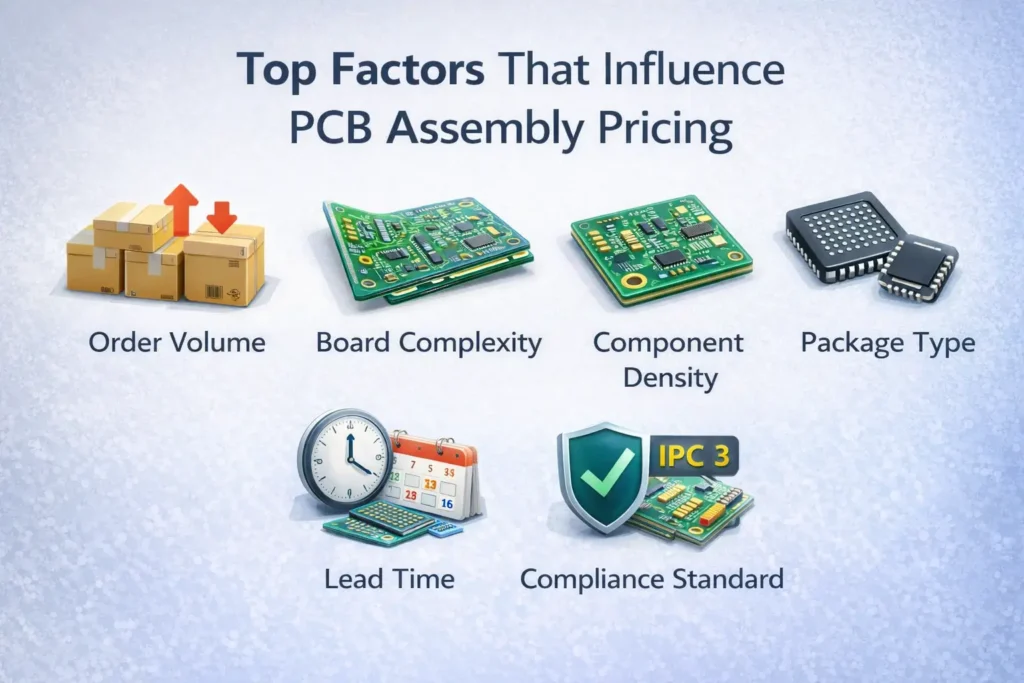
Order Volume (Economies of Scale)
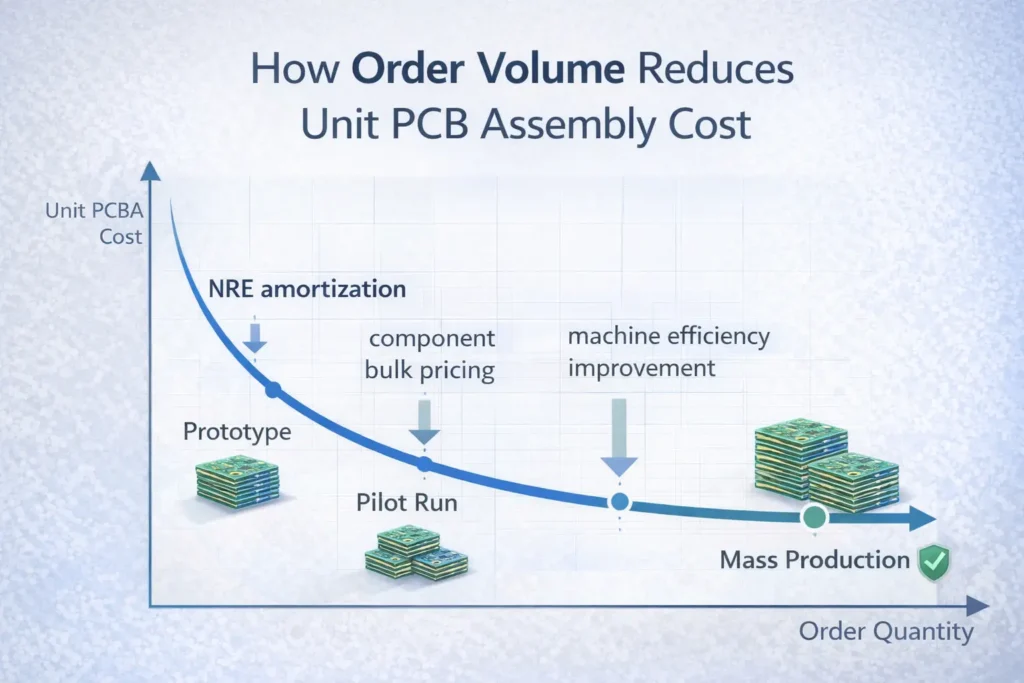
- Prototyping: High unit cost due to NRE fees and lack of bulk component discounts.
- Mass Production: This is where cost optimization happens. Engineering fees are fully amortized, and machine utilization is maximized.
Board Complexity and Component Density
- High-Density Interconnect (HDI): Boards with blind/buried vias require laser drilling, which is more expensive.
- Package Type: Micro-components (0201, 01005) and fine-pitch BGAs (0.4mm pitch) require higher precision and slower machine speeds, driving up the assembly fee.
Turnaround Time (Lead Time)
Need it in 24-48 hours? Expedited orders require shifting production schedules, paying overtime, and sourcing “spot stock” components at a premium. Standard lead times (2-3 weeks) always offer the best value.
Compliance and Standards
Following IPC Class 3 (Medical/Aerospace) instead of IPC Class 2 (Consumer) requires stricter process controls and more frequent inspections, which adds to the labor cost.
How to Reduce PCBA Cost (The Engineer’s Perspective)
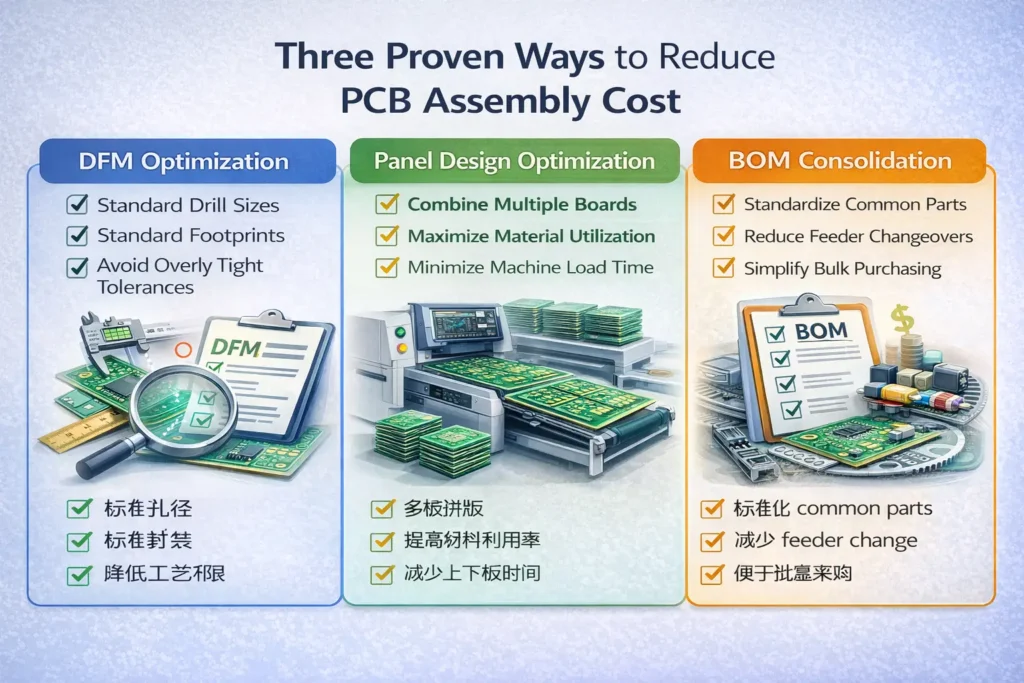
Strategy 1: DFM (Design for Manufacturing) Optimization
Reduce complexity by minimizing the number of unique drill sizes and using standard footprints. Avoid pushing the limits of your manufacturer’s capabilities unless technically necessary.
Strategy 2: Optimize Panel Design
By arranging multiple PCBs onto a single large panel, you maximize material utilization and reduce the time machines spend loading/unloading boards. Square or rectangular boards are the most efficient for panelization.
Strategy 3: Consolidate Your BOM
Try to use “Common Parts.” Instead of having five different 10k resistors from five different brands, standardize one part number across your design. This reduces “feeder changes” on the production line and allows for bulk purchasing.
Hidden Costs to Watch Out for in International PCBA Sourcing
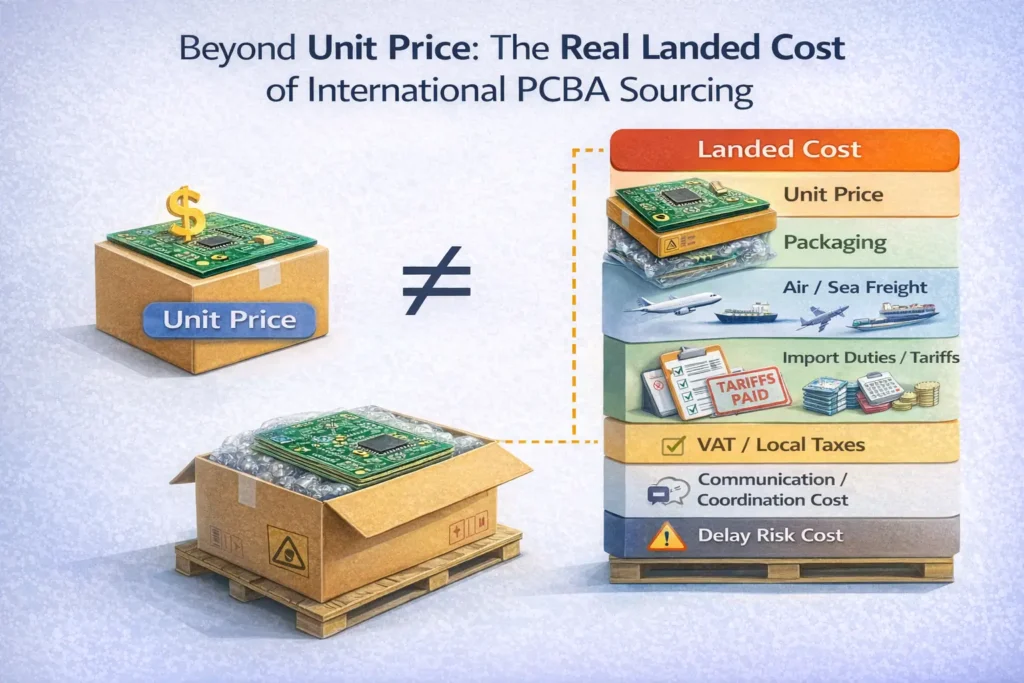
For Western buyers, the “Unit Price” isn’t the “Landed Price.”
- Packaging and International Logistics: Air freight is fast but expensive; sea freight is economical for mass production but adds weeks to the timeline. Don’t forget the cost of ESD-safe packaging.
- Import Duties and Taxes: Be aware of Import Duties (such as Section 301 tariffs for US customers) and VAT. Using the correct HS Code is critical to avoid fines.
- Communication and Management Costs: Misunderstandings due to time zones or language barriers can lead to costly errors. Working with an experienced Shenzhen partner provides English-speaking engineering support to bridge these gaps and ensure efficient project coordination.
Why Shenzhen is the World’s PCBA Hub
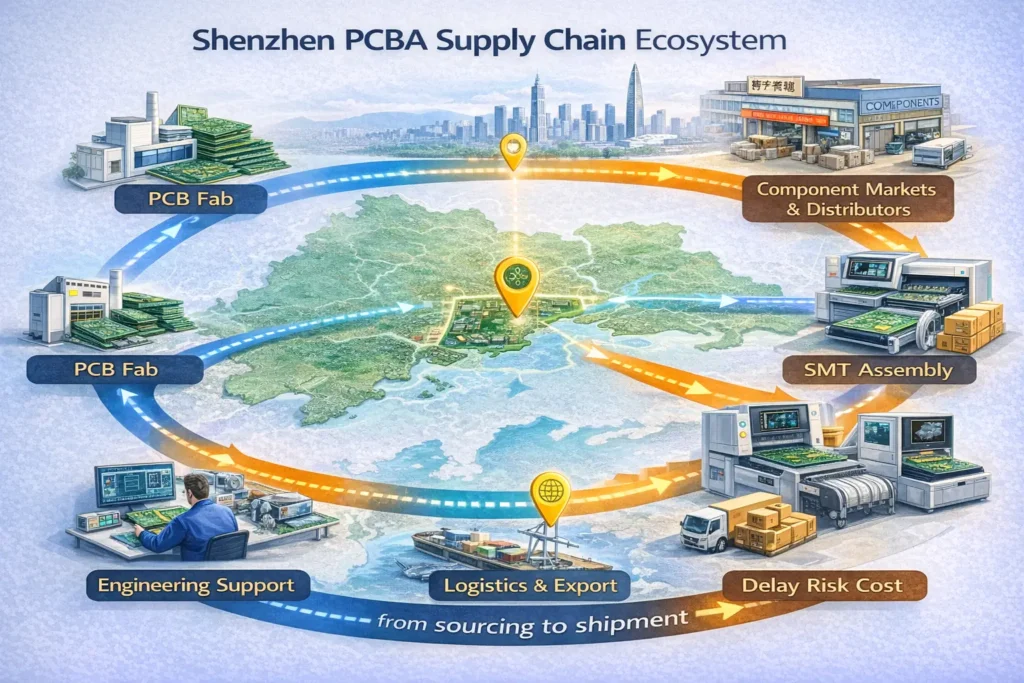
Partnering with a Shenzhen-based factory offers unique competitive advantages:
- The Ecosystem Advantage: Within a small geographical radius, we can source any component—from standard resistors to rare ICs—significantly reducing lead times and project risks.
- Advanced Manufacturing Technology: Shenzhen factories utilize the latest high-speed SMT lines and precision inspection equipment (3D AOI, X-Ray) to handle complex designs and micro-components.
- Cost-Effective Engineering & Flexible Services: We offer deep engineering expertise, from DFM analysis to full PCB layout support. Our flexible manufacturing model excels at “High-Mix, Low-Volume” production and rapid prototyping, accelerating your product development cycle.
FAQ
How long does a PCBA quote typically take?
With complete Gerber files and a Bill of Materials (BOM), most reputable manufacturers, including us, can provide a detailed quote within 24-48 hours.
What is DFM and why is it important for cost savings?
DFM stands for Design for Manufacturing. It’s a process where engineers review your design before production to identify potential issues that could increase costs or reduce yield. Optimizing DFM can lead to significant savings by simplifying assembly, reducing material waste, and improving overall efficiency.
How does order volume affect PCBA costs?
Order volume has a massive impact. For small prototype runs, the high one-time engineering (NRE) and setup costs are spread over fewer units, making the per-unit price very high. As order quantity increases into mass production, these fixed costs are amortized, dramatically lowering the cost per PCB assembly.
What's the difference between Consigned and Turnkey PCBA services?
In Consigned service, you (the customer) source and provide all the components to the assembly house. In Turnkey service, the assembly house manages the entire process, including component sourcing. Turnkey is often more cost-effective and efficient for international buyers due to consolidated logistics and bulk purchasing power.
How do international shipping costs and duties affect the final PCBA price?
International shipping (air or sea freight) and potential import duties (like Section 301 tariffs for US shipments) can add a significant percentage to your final cost. It’s crucial to factor these into your budget. Working with an experienced Shenzhen partner can help navigate these complexities and optimize logistics for the best landed cost.
Achieving the Best Total Cost of Ownership
PCB assembly cost is about more than just finding the lowest quote; it’s about finding the best Total Cost of Ownership (TCO). By understanding the drivers and optimizing your design for manufacturing, you can reduce costs without sacrificing quality.
Ready for a transparent quote?
Upload your Gerber and BOM files today. Our engineering team will provide a Free DFM Review and a detailed cost breakdown within 24 hours.