
Table of Contents
What Is Turnkey PCBA? A Complete Guide to One-Stop PCB Assembly
Overview
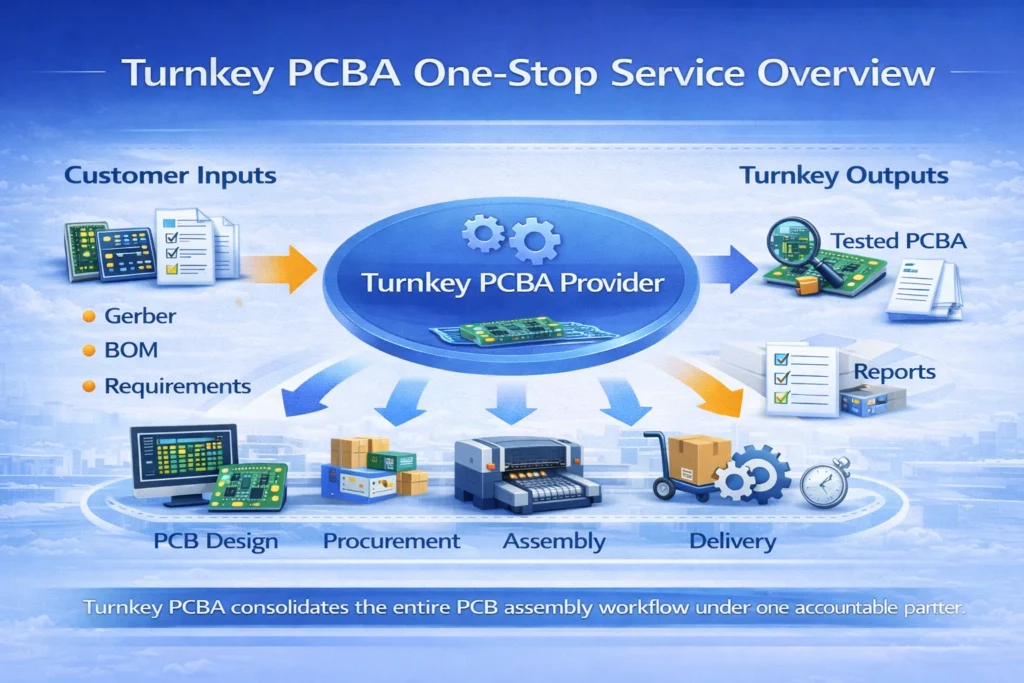
Turnkey PCBA is a one-stop, end-to-end electronics manufacturing service model. Its core idea is that all stages of printed circuit board assembly—from design through finished product delivery—are integrated and fully managed by a single service provider. The customer only needs to communicate requirements or provide the final product objective, without coordinating multiple suppliers. This can significantly shorten time-to-market and reduce coordination effort and production cost.
Advantages of Turnkey PCBA
Value for Engineering Teams
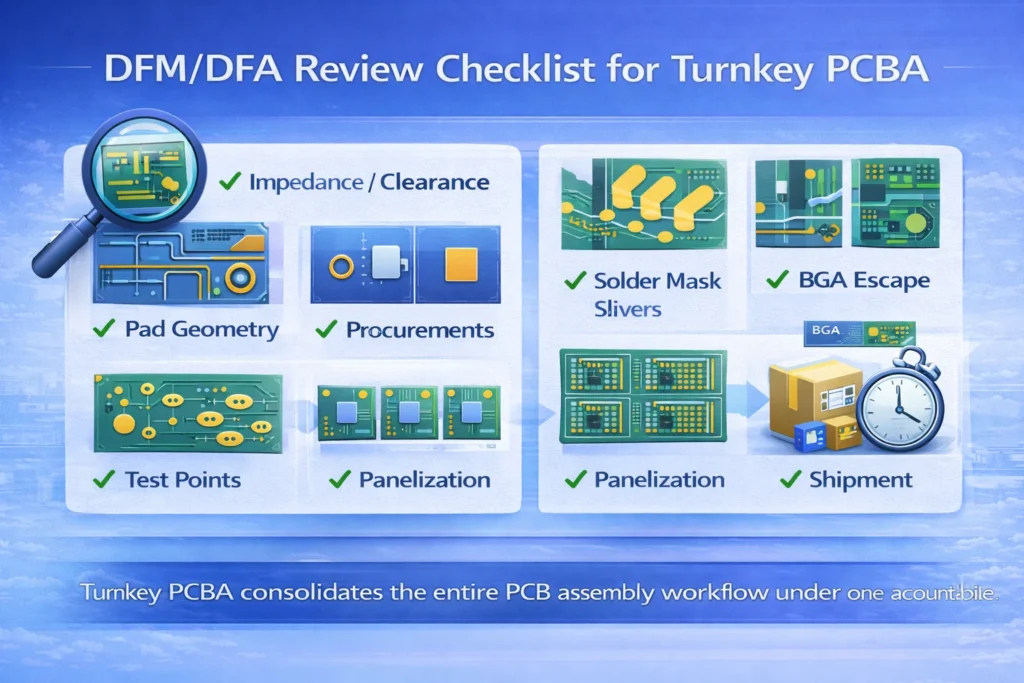
1. Design verification and risk front-loading:
At the early stage of a project, a turnkey PCBA provider can perform DFM (Design for Manufacturability) and DFA (Design for Assembly) reviews to identify and correct hidden issues—such as signal integrity, power layout, and pad design—before design release. This reduces the risk and cost of later redesigns or even full-batch scrap caused by design defects.
2. Component selection and supply-chain support:
The provider’s BOM engineering team can leverage a large parts database and supply-chain resources to propose validated alternates early. This helps optimize cost and lead time while maintaining required performance.
In a turnkey model, the same technical team supports the project end-to-end, which shortens communication loops. Manufacturing data collected during prototyping can be directly reused for process optimization in volume production—enabling a smoother ramp and reducing quality and schedule risks associated with supplier changes or process transfers.
Value for Procurement Teams
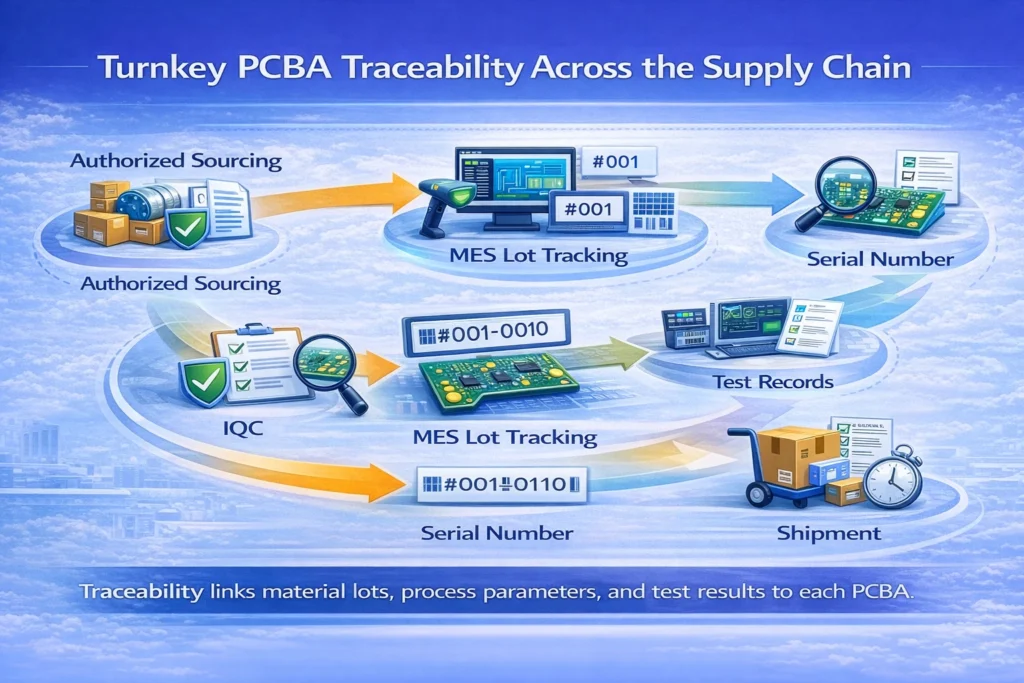
1. Cost optimization and higher purchasing efficiency:
With scale purchasing power, turnkey providers can often obtain more competitive component pricing from original manufacturers or authorized distributors.
2. Supply assurance and quality accountability:
With stable supply channels and strict IQC (Incoming Quality Control), the provider can help ensure component authenticity and compliance—while making responsibility clearer.
3. Simplified workflow and closed-loop traceability:
Turnkey PCBA consolidates PCB fabrication, material procurement, SMT/DIP assembly, and testing under unified management systems. This enables end-to-end process linkage and data traceability across stages.
Turnkey PCBA Process
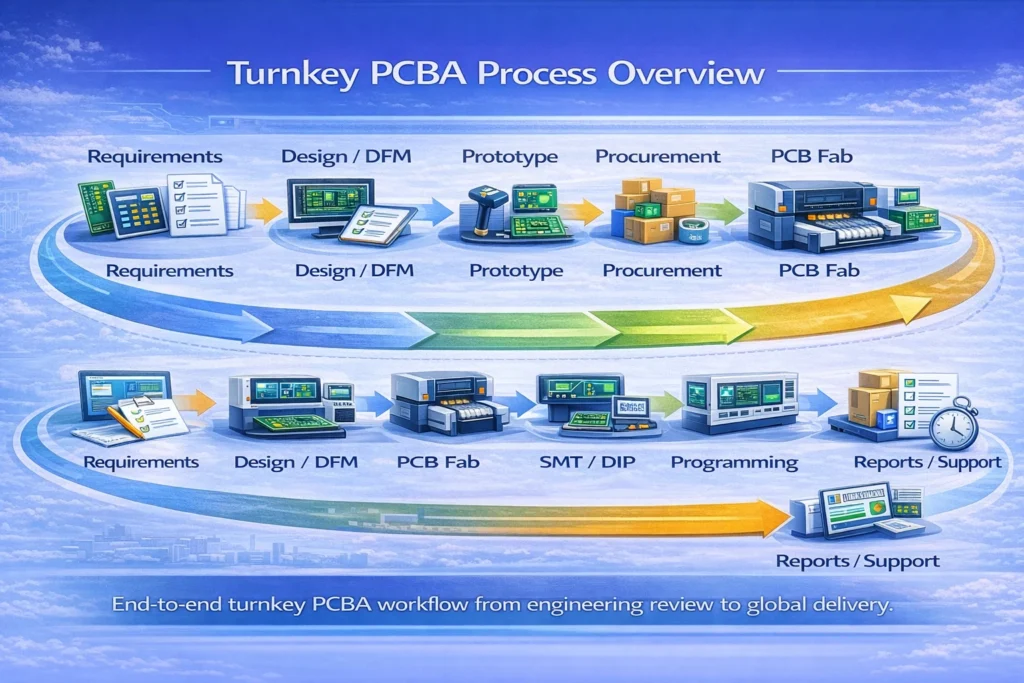
Design and Prototyping
Requirement Communication
The turnkey PCBA provider’s technical team confirms product functional requirements, performance targets, application scenarios, and budget/timeline.
Solution definition:
For customers with complete design documentation, the team reviews the files and provides optimization suggestions.
For customers with only a concept, the provider may offer one-stop design services from circuit design and PCB layout to mechanical/structural design.
Design Review and Optimization (DFM)
Engineers analyze customer files such as Gerber data and BOM lists and conduct manufacturability checks. This includes verifying key factors such as hole spacing, routing, and impedance, optimizing routing and pad design, and identifying risks that could cause manufacturing defects.
Prototype build and validation:
After the solution is confirmed, the provider runs small-batch prototyping or a pilot build. The workflow is broadly consistent with volume production, and real assembly/testing is used to validate circuit functionality, mechanical fit, and process stability to ensure the design is ready.
Manufacturing and Assembly
Raw Material Management and Procurement
Based on the BOM, the provider sources components through original manufacturers or authorized channels to ensure authenticity and traceability. All incoming materials undergo strict incoming inspection, including appearance checks, specification verification, and electrical performance checks where required.
PCB fabrication
PCBs are manufactured according to design files and can meet requirements for different materials, layer counts, thicknesses, and surface finishes.
SMT Assembly
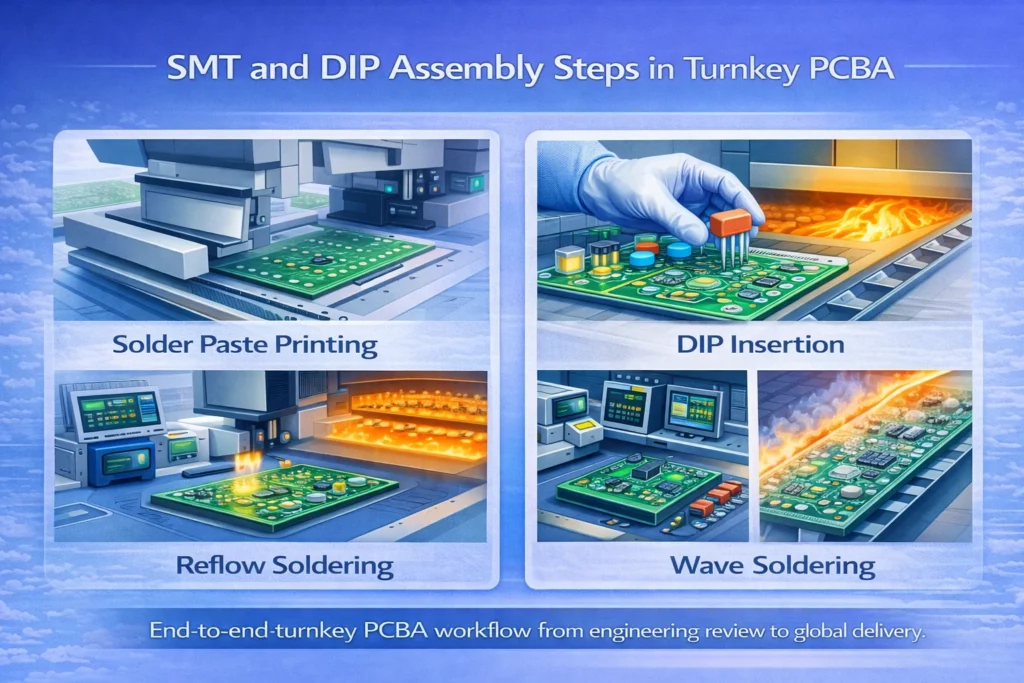
Solder paste printing is performed first using high-precision stencils to ensure print quality. Fully automatic pick-and-place machines mount miniature components at high speed and precision. Boards then pass through reflow ovens where controlled thermal profiles complete soldering.
DIP insertion and wave soldering
For through-hole components unsuitable for SMT, manual or automated insertion is performed, followed by wave soldering to complete joints.
Process Quality Control
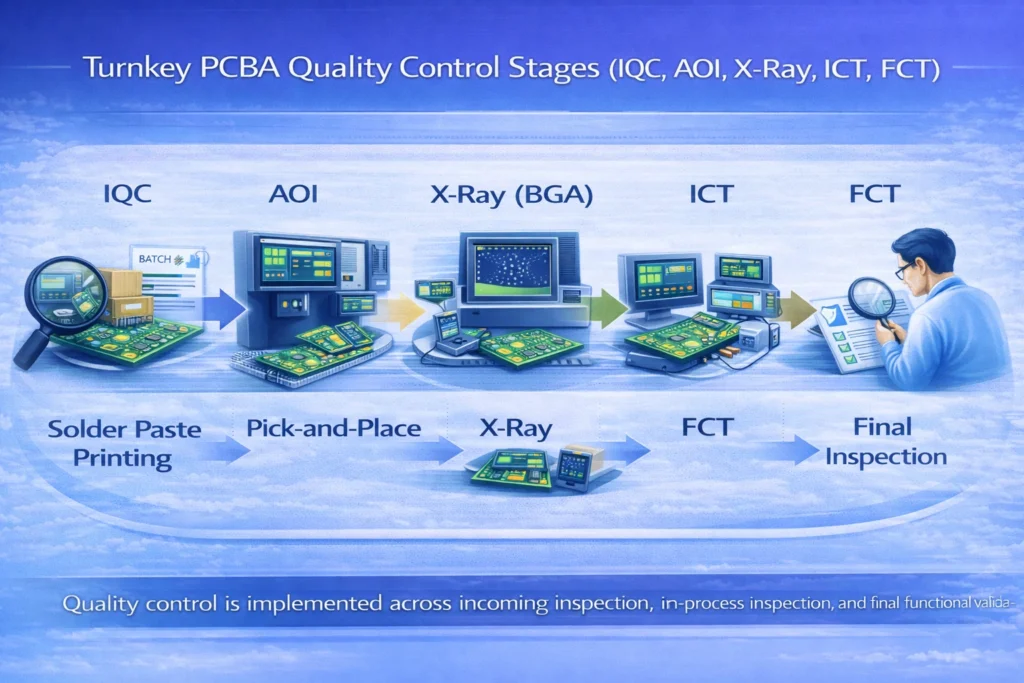
Multiple quality gates run throughout production. For example, AOI (Automated Optical Inspection) checks placement defects after SMT. X-ray may be used for hidden joints such as BGAs. Production environment and equipment status are checked and calibrated before production as well.
Testing and Quality Assurance
In-Circuit Testing (ICT)
ICT primarily checks soldering quality and whether components are installed correctly. It can quickly locate process defects such as shorts, opens, and weak solder joints.
Functional Testing (FCT)
FCT simulates real operating conditions to verify that all functions meet design requirements. The provider customizes test programs and fixtures based on the customer’s test plan, making FCT a key step for performance confirmation.
Programming
Control programs are downloaded into the main controller so the board can operate as designed.
Reliability Testing
Depending on product requirements, reliability evaluations may include burn-in testing, temperature/humidity testing, drop testing, and other methods to assess stability and lifetime under harsh conditions.
Final Inspection
Before packaging, boards undergo comprehensive re-inspection of appearance, marking, and function to ensure every delivered unit meets acceptance requirements.
Delivery and Post-Production Support
Packaging and Logistics
Based on product characteristics, appropriate packaging materials (ESD bags, foam, returnable boxes, etc.) are used to prevent damage during transport. Logistics is then arranged to deliver finished products to the customer.
Document Delivery
In addition to physical products, the provider typically supplies production reports, test data, and material traceability records to ensure transparency and auditability.
After-Sales Technical Support
Strong after-sales support enables long-term cooperation. This may include fast responses to technical inquiries, failure analysis reports, assistance in resolving mass-production process issues, and NPI (New Product Introduction) support for pilot runs.
Why Choose Turnkey PCBA Service
Cost-Effectiveness and Budget Control
Lower procurement and supply-chain cost:
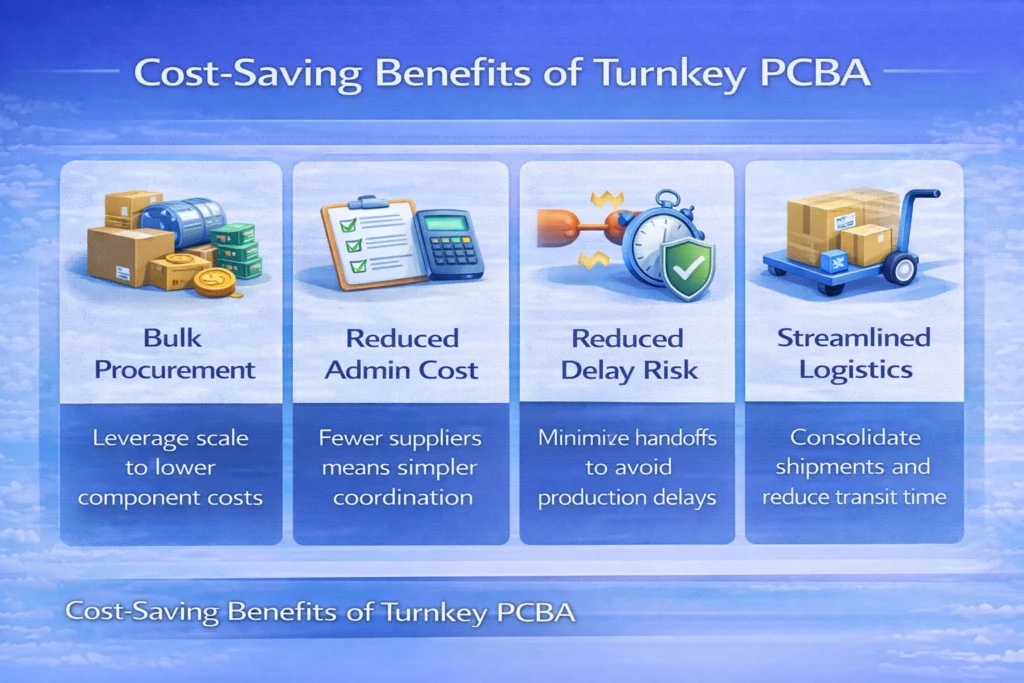
With scale, the provider can centrally procure components through original or authorized channels, obtain more competitive pricing, and reduce risks of high unit pricing and counterfeit parts often associated with small-batch purchasing—thereby lowering material cost.
Reduced management and hidden cost:
Customers do not need to build their own factory, procurement team, or warehousing system. They also avoid extensive manpower spent coordinating and managing logistics across multiple suppliers (PCB fabs, component vendors, assembly houses). This reduces equipment investment, facility costs, and cross-department labor cost.
Optimized cash-flow and inventory exposure:
Customers do not need to stock large inventories in advance or carry component inventory risks. The provider typically manages kitting and materials, improving cash-flow efficiency.
Streamlined Communication and Efficiency
Single point of contact with clear responsibility:
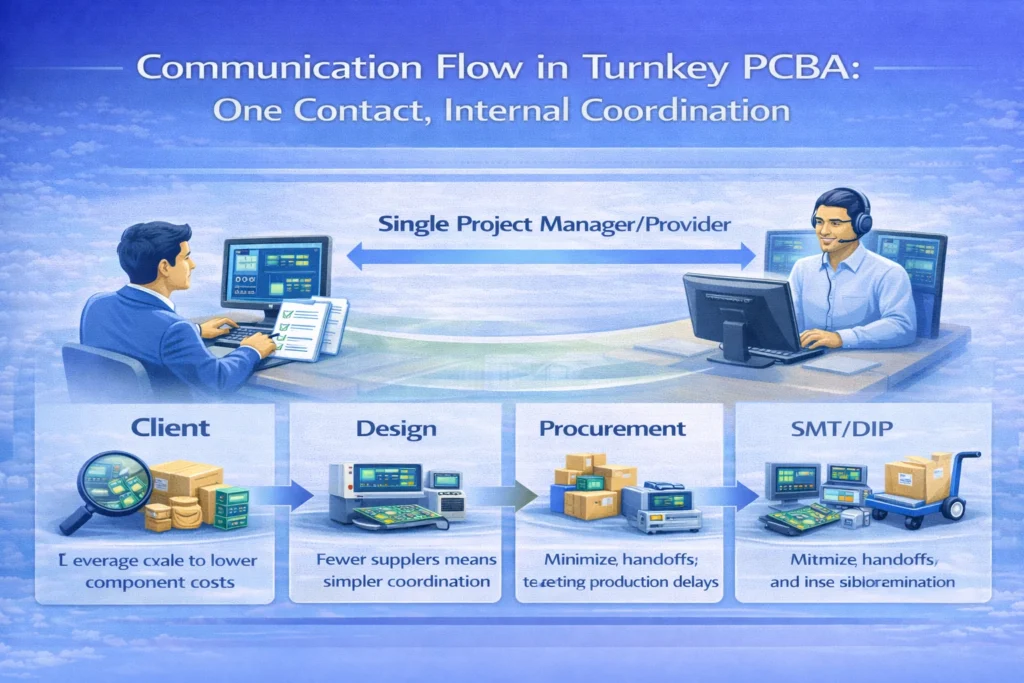
Customers work with one provider. All design, material, production, and quality issues are coordinated internally, reducing the complexity of dealing with multiple stages and suppliers, and lowering communication cost.
Efficient internal collaboration:
Professional turnkey providers use digital systems to enable real-time data sharing and seamless workflow linkage from design to production. Design files can be imported directly into production systems and parameters synchronized automatically, reducing errors and waiting time and improving collaboration efficiency.
Freed internal resources:
Engineering and procurement teams can focus less on manufacturing coordination and supplier management, and more on higher-value work such as product development and market expansion.
Reduced Time-to-Market
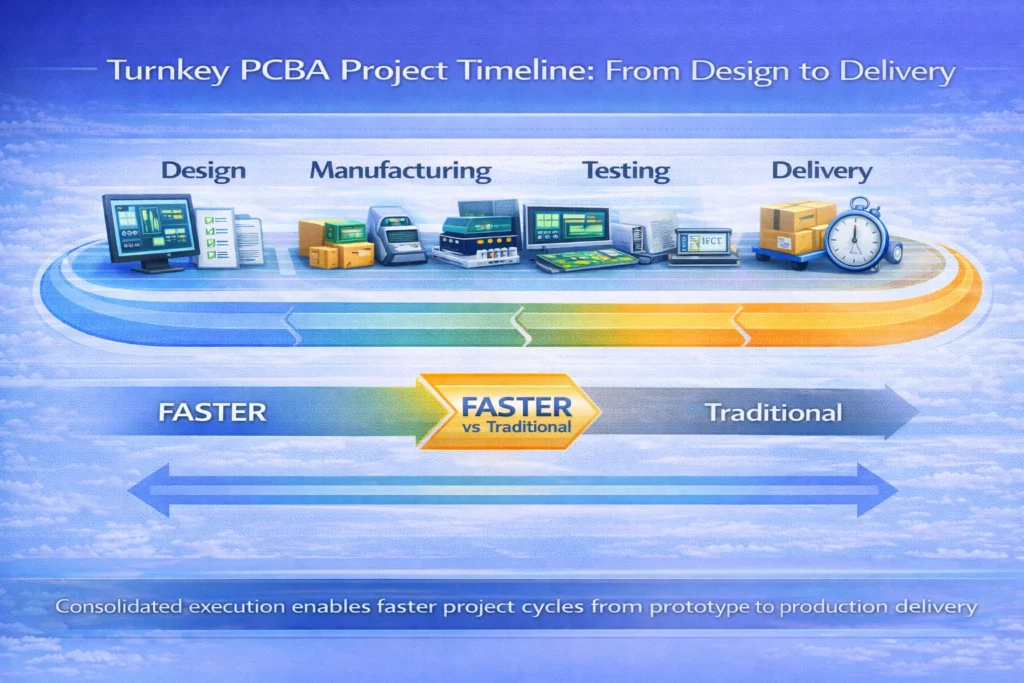
Parallel execution and fast response:
Providers can run PCB fabrication, material procurement, and SMT assembly in parallel with close coordination.
Early engineering involvement to avoid risk:
DFM analysis and other early technical support help identify and correct design risks early, avoiding rework and delays during mass production.
Supply-chain assurance and fast kitting:
With mature supply networks and inventory management, providers can quickly kit required materials and reduce uncertainties caused by component sourcing—the largest lead-time risk factor—so production is less likely to stop due to shortages.
When to Choose Turnkey PCBA Service?
Ideal Scenarios for Turnkey PCBA
Companies with limited resources or those focusing on core business:
For startups, small R&D teams, or companies outside the electronics industry, turnkey PCBA reduces capital and labor investment in non-core manufacturing tasks, allowing teams to focus on product definition, software development, and go-to-market work.
Industries with strict supply-chain and regulatory compliance requirements:
In medical electronics, automotive electronics, and industrial control—where reliability, compliance, and documentation requirements are stringent—turnkey providers deliver strong value. These industries often require tight component traceability, consistent process control, and proof of compliance. A professional turnkey provider can reduce compliance pressure and project risk.
Complex products or projects requiring fast launch:
When products involve high-density assembly, mixed processes, or complex testing, coordinating multiple suppliers can increase delays and communication cost. Turnkey providers integrate design review, sourcing, manufacturing, and testing, enabling parallel progress and shorter design-to-delivery cycles.
Projects impacted by supply-chain volatility and shortages:
With scale purchasing power, diversified sourcing channels, and validated alternate databases, turnkey providers can better ensure supply continuity.
Comparison with Traditional PCB Assembly Services
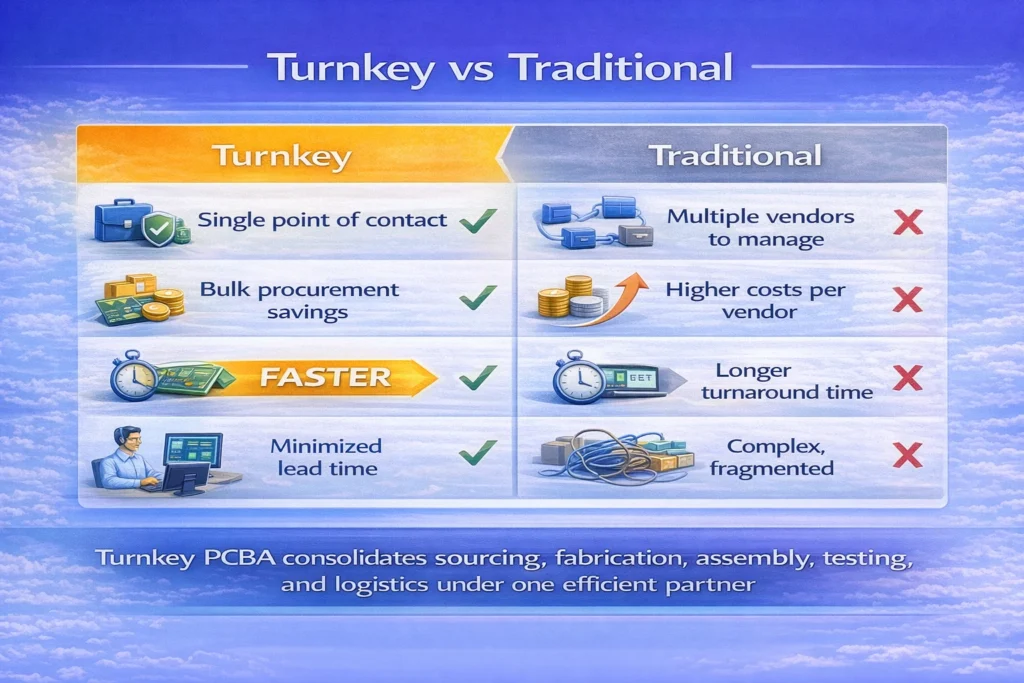
| Aspect | Traditional PCB Assembly | Turnkey PCBA Service | Key Differences and Advantages |
|---|---|---|---|
| Responsibility and Communication | Multiple independent entities | One service provider | Clear responsibility and efficient communication |
| Supply Chain and Management Burden | Customer manages all parts of supply chain | Provider manages procurement, supply chain, and logistics | Reduced supply chain risk and better cost control |
| Cost Structure and Control | Transparent individual prices but higher hidden costs | Competitive total cost with optimized processes | More predictable total cost and reduced hidden risks |
| Quality and Risk Control | Quality responsibility distributed | Integrated quality control system | Higher quality consistency and traceability |
| Design-to-Manufacturing Coordination | Disconnected teams leading to potential design flaws | Early involvement of manufacturing knowledge, optimized designs | Faster and more efficient product development |
How to Ensure Turnkey PCBA Project Success
PCBA Industry Standards and Certifications
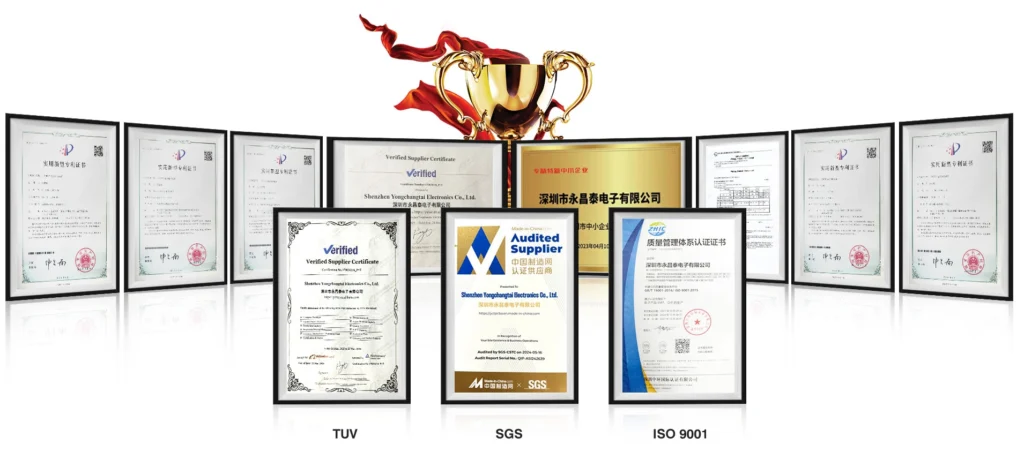
Basic quality management system: ISO 9001
ISO 9001 is an internationally recognized quality management system standard designed to ensure process consistency and traceability. For any PCBA manufacturer, ISO 9001 certification demonstrates baseline quality control capability and is a foundation for customer trust.
Industry-specific certifications (for high-reliability applications)
IATF 16949: Automotive quality management certification with strict audits of technology, equipment, and process control. Holding this certification indicates capability to meet automotive electronics PCBA requirements.
ISO 13485: Medical device quality management certification with strict requirements for document control, record control, risk management, and working environment. Choosing a manufacturer with ISO 13485 supports medical PCBA compliance needs.
UL certification: A key mark for product safety. For PCBA, in addition to end-product certification, there is also factory-related VZQC2 certification focused on component traceability and standardized manufacturing of semi-finished products such as PCBA, supporting downstream traceability and supplier qualification.
Environmental and market access compliance
RoHS: Environmental regulation restricting hazardous substances, often required for EU market access.
CE: Indicates compliance with EU requirements for safety, health, and environmental protection for entry into the European Economic Area.
Effective Quality Control Practices in PCBA
Upstream control: strict material management and IQC
Quality control starts with raw materials. Manufacturers should build a strict supplier evaluation system to ensure the quality of components and bare boards at the source. After materials arrive, strict incoming inspection (IQC) is required to verify appearance, specifications, and performance parameters, and to test electrical performance for critical components where necessary. For medical electronics and other regulated projects, RoHS/REACH compliance also needs verification. This is the first gate to prevent batch defects caused by material issues.
In-process control: multiple quality gates during production
DFM/DFA review: Review customer files early to optimize manufacturability and assembly, preventing production issues from the design stage.
SMT control: Use high-precision placement machines and AOI to monitor placement position and angle, and detect missing parts, misalignment, and polarity errors.
Soldering process control: Strictly control reflow and wave soldering parameters to form reliable joints, and use visual inspection and ICT to detect weak joints and bridging.
Hidden defect inspection: Use X-ray for BGAs and other hidden joints to identify voids, bridging, and internal defects.
Functional and reliability validation: Run FCT based on customer specifications to confirm electrical and logic functions. For high-reliability products, additional reliability verification may include ESS, burn-in, etc.
Final inspection and traceability: last assurance before shipment
Before packaging and shipment, final inspection checks appearance and functionality. More importantly, for medical and automotive electronics, end-to-end traceability is essential. MES systems record component batch numbers, purchase dates, placement locations, and process parameters so that any quality issue can be traced back to the source, supporting strict regulatory requirements.
Continuous improvement: closing the quality loop
Effective quality control is not a one-time activity—it is a continuous improvement cycle. This includes internal quality feedback mechanisms, root-cause analysis and corrective actions, and serious handling of customer quality feedback to continuously optimize processes.
How to Choose a Turnkey PCBA Manufacturer
Comprehensive capability and industry experience
Factory ownership and equipment capability:
First, confirm the supplier has its own physical factory and production lines—not merely a trading company. On-site audits or video factory tours are important. Check whether SMT lines, DIP lines, and inspection equipment (AOI, SPI, X-ray) are complete and advanced. High-end applications may require support for 01005 components, BGA, PoP (Package on Package), and other precision assembly capabilities.
Process capability and industry fit:
Manufacturing capability must match your product complexity. Industrial control, medical, and automotive electronics require higher reliability, process control, and certifications, while consumer products may prioritize efficiency and cost. Prefer manufacturers with proven cases and experience in your target industry.
Quality system and certifications:
Reputable suppliers should hold ISO 9001 certification. If your product belongs to regulated industries, verify industry certifications such as IATF 16949 (automotive) and ISO 13485 (medical). These indicate systematic and standardized quality management.
Supply-chain and material assurance:
A core of turnkey service is procurement and kitting. Reliable suppliers should have transparent sourcing channels (original manufacturers, authorized distributors) and be able to provide purchase records to prevent counterfeit or refurbished parts. Strong supply chains also enable faster kitting and validated alternates during shortages.
Customer service, communication, and technical support
Early engineering collaboration:
Strong suppliers provide early DFM support and design-stage input to reduce downstream issues, lower cost, and accelerate timelines. They should act as a “partner,” not only a processor.
Response speed and communication channels:
Evaluate responsiveness and communication options (phone, email, online systems). Fast response reduces project downtime. Some leading providers offer full digital workflows for quoting, ordering, and production tracking, improving transparency and efficiency.
Delivery reliability and flexibility:
Assess standard lead times, expedite capability, and volume production stability. Also confirm rapid prototyping support (e.g., 24–48 hours) and flexible small-batch production, which is critical for fast iteration.
After-sales service and issue resolution:
Understand after-sales processes, including quality feedback mechanisms, return/rework policies, and technical support. Responsible suppliers take accountability and resolve issues quickly.
Inspection capability and traceability
End-to-end inspection system:
From IQC to in-process control (IPQC) to final testing, every stage should be controlled. Confirm which inspection/test equipment is available: AOI, X-ray (for BGAs), ICT, FCT, etc. Robust testing reduces customer risk.
Traceability:
For high-reliability products, full traceability is essential. MES systems should trace material lots, process parameters, and test records per PCBA, supporting problem analysis and potential recalls.
Cost Optimization, Capacity, and Overall Long-Term Value
Transparent pricing and total cost:
Request transparent quotation details and confirm whether all process and testing costs are included. Be cautious of low-price traps. Evaluate total cost of ownership (TCO), including potential risk costs caused by quality or delivery issues. One-stop services often reduce TCO through integrated supply chains and optimized processes.
Capacity evaluation and fit:
Do not only count the number of production lines—understand actual capacity utilization and whether future volume needs can be met. Some factories reserve dedicated lines for key customers. Also evaluate how flexibly capacity can handle order fluctuations.
Long-term partnership value:
Long-term customers often indicate reliability and satisfaction. Choosing a manufacturer that can support you from prototyping and pilot builds through mass production reduces future switching costs and risks.